In RESTful APIs, paths should be semantic to the client
Hierarchical and descriptive path such as
fashionboutique.com/customers/223/orders/12
Accessing a single resource would need an id appended to the path
Referring to list or collections of resources does not entail adding an id
an optional message body containing data
Sending responses
Content types
When server sends a data payload to the client, there must be a
content-type in the header of the response
Match with one of the options in the Accept field of the request
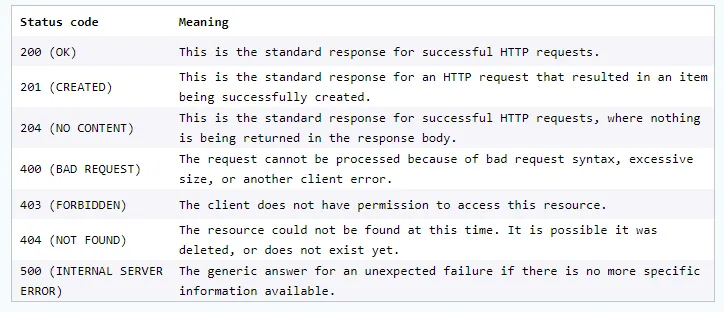
Response codes - Alert the client to info about the success of the operation
HTTP request types
HTTP standard specifies two properties for request types: safety and
idempotency
HTTP GET and HEAD requests should be safe
Taking no actions other than retrieval
Cause no side effects on the server
Adhering to RESTful principles in our API guarantees safe GET and HEAD
requests
All HTTP requests except POST should be idempotent
The side effects of N > 0 identical requests are the same as for a single
request
Adhering to RESTful principles in our API guarantees idempotent GET, HEAD,
PUT, and DELETE requests
Same origin policy and CORS
A URL’s origin is defined as protocol (scheme) + hostname + port
http://example.com:80/index.html
protocol: http
host: example.com
port: 80
If the referenced resource (from the fetched HTML document) is fetched using
a URL that does not have the same origin as the source HTML, the browser
will have to check the Access-Control-Allow-origin response header
If it contains * or the URL of the source HTML, the browser will process
the response, otherwise it will refuse to process it and throw an error
Same-origin policy is a security mechanism implemented by browsers to
prevent session hijacking and other security vulnerabilities
Legitimate cross-origin requests are enabled with CORS
Allows restricted resources (images, stylesheets, scripts, iframes, and
videos) to be requested from another domain outside the domain from which
the resource was served
But by default, JS code that runs in a browser can only communicate with a
server in the same origin
Backend web architecture
Components
The server. This is the computer that receives requests
Personal computer used as server during development
The app. This is the application running on the server that listens for
requests, retrieves information from the database, and sends a response
Contains logic about how to respond to various requests based on the
HTTP verb and the URI
Route is a pair of an HTTP verb and a URI
Routing is matching requests to appropriate routes/endpoints, which
triggers handler functions to process and send a response
Some of these handler functions will be middleware
Middleware might modify the request object, query the DB, or otherwise
process the incoming request
Ends by passing control to the next middleware function, rather than
sending a response
One middleware ends the request-response cycle with a response to the
client
Each route can have one or many handler functions that are executed when
a request to that route is matched
The database. Databases are used to organize and persist data.
An interface to save data in a persistent way to memory
Reduces load on memory of main server and allows data persistence when
server down
Requests to server might require DB queries
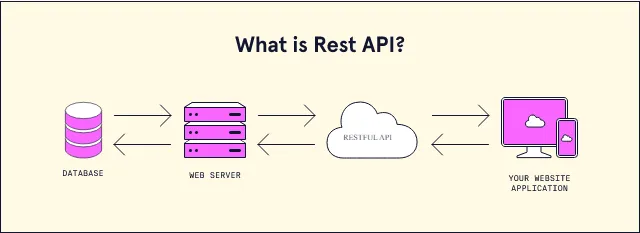
Web API
An interface created by the back-end
A collection of endpoints and the resources these endpoints expose
Defined by the routes it defines, and responses client can expect
One Web API can provide data from different front-ends
Backend frameworks
Common features
Work directly with HTTP requests and responses
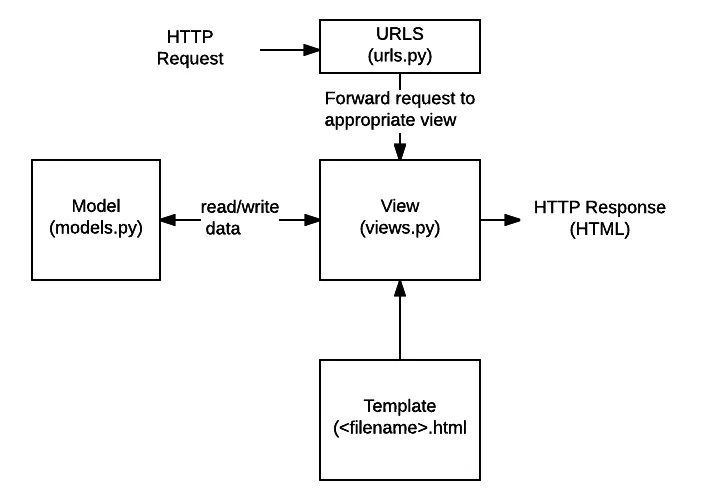
Every “view” function (a request handler) receives an HttpRequest object
and return an HttpResponse object
HttpRequest contains request information
HttpResponse contains the formatted output
Routing requests to appropriate handlers
Map URL patterns to specific handler functions
Interacting with DBs
Object-Relational Mapper (ORM) is an abstraction database layer that
abstracts DB read, write, query, and delete operations
ORM benefits
Can change underlying DB implementation without changing the code that
uses it
Validation of data can be implemented within the framework
The model is the object used to define the structure of a record
Specifies field types, which may provide field-level validation
Field definition help specify their maximum size, default values,
selection list options, help text for documentation, label text for
forms etc.
Supporting sessions and user authorization
Formatting output (HTML, JSON, XML)/Rendering data
Provides templating systems for HTML, JSON, or XML output
Placeholders in the templates will be replaced with values passed in
from the view function when the page is rendered
Improving security against web attacks
Node.js
An asynchronous event-driven JavaScript runtime designed to build scalable
network applications
JS runtime means that you can run JS from any machine without going
through a web browser
Adds some functionality to browser-based JS
Read and write local files
Create HTTP connections
Listens to network requests
In the browser, you do not have access to Node APIs like filesystem access
functionality
In Node, you do not have access to the DOM, or Web Platform APIs, or
objects provided by the browser
Node assumes it’s always running in a dev environment
By setting NODE_ENV=production environment variable, you can signal Node
that you are running in prod
Execute the command export NODE_ENV=production in the shell
Or put it in shell config file (e.g .bash_profile with the Bash shell)
Can also apply the environment variable by
NODE_ENV=production node app.js
TypeScript → TS compiler → JS → Node.js
Tell the OS which interpreter to use for running JS scripts with a “shebang”
line
#!/usr/bin/env node
The script should have executable permissions
chmod u+x app.js
The process core module of Node provides the env property that hosts all
environment variables that were set at the moment the process was started
USER_ID=239482 USER_KEY=foobar node app.js
Passes the user USER_ID and USER_KEY
process.env.USER_ID; // “239482”
process.env.USER_KEY; // “foobar”
Accesses the environment variables inside the script
Configure bash scripts to export variables in prod
Create an .env file in the root directory of project and use dotenv
package to load them during runtime
# .env file
USER_ID=“239482”
USER_KEY=“foobar”
NODE_ENV=“development”
# .js file
require(‘dotenv’).config();
process.env.USER_ID; // “239482”
process.env.USER_KEY; // “foobar”
process.env.NODE_ENV; // “development”
Make HTTP requests with the Axios library or the HTTPS core module
Interact with the file system using the fs core module
json-parser middleware should be among the very first
unknownEndpoint should be next to the last middleware, just before the
error handler
A router object is an isolated instance of middleware and routes
Think of it as a mini-application capable only of performing middleware
and routing functions
Every Express app has a built-in app router
Use express-async-errors to eliminate try-catch blocks while using
async/await
If an exception occurs in an async route, the execution is automatically
passed to the error handling middleware
User admin
In relational DBs, save user’s ID as foreign key for respective object
Can do all sorts of stuff in document DBs because they don’t support join
queries
Schema-less DBs like Mongo require radical design decisions about data
organization
Token authentication
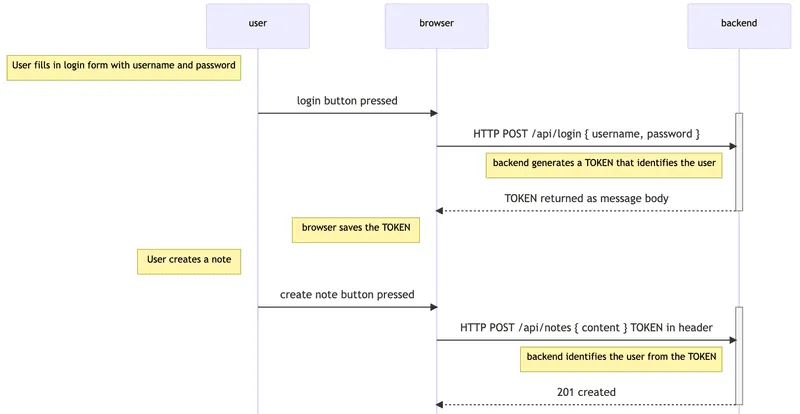
User starts by logging in using a login form implemented with React
This causes the React code to send the username and the password to the server
address /api/login as a HTTP POST request
If the username and the password are correct, the server generates a token
that somehow identifies the logged-in user
The backend finds the user in the DB with the supplied username and compare
password with stored passwordHash
The token contains the username and user id in an encrypted form, which can be
decoded in authorized endpoints to obtain the original username and userid
using the same secret string used to sign the token → do not need to include
username and user id in every request, only need to login, get token and
include token with every request
The token is signed digitally, making it impossible to falsify (with
cryptographic means)
The backend responds with a status code indicating the operation was
successful and returns the token with the response
The browser saves the token, for example to the state of a React application
When the user creates a new note (or does some other operation requiring
identification), the React code sends the token to the server with the request
The server uses the token to identify the user
Can use express-jwt for multiple interfaces requiring identification
Token authentication must always be used over HTTPS
Problems of token-based authentication
API has a blind trust to the token holder
To revoke the access rights of the token holder - Limit the validity period
of a token - Safer the shorter the period is - requires more re-logins -
Save info about each token to backend DB and check for each API request if
the access right corresponding to the token is still valid - Called
server-side session - Increased complexity and performance hit - Common to
save the session corresponding to a token to a key-value DB (Redis) - Token
can just be a random string - Cookie can be used instead of Authorization
header
Django
Should use same DB for prod and dev
MongoDB
Stores data records as documents, gathered together in collections
A database stores one or more collections of documents
Document databases like Mongo are schemaless
Mongoose
High-level API to use MongoDB directly in JS code, better than the official
MongoDB Node.js driver library
An object document mapper (ODM)
The idea of Mongoose is that data stored in DB is given a schema at the
application level that defines the shape of the documents stored in any
given collection
Saving JS objects as Mongo documents is straightforward
Schema
In Mongoose, everything is derived from a schema
Each schema maps to a MongoDB collection and defines the shape of the
documents in that collection
Each key in the schema defines a property which will be cast to its
associated SchemaType
Permitted SchemaTypes
String
Number
Date
Buffer
Boolean
Mixed
ObjectId
Array
Decimal128
Map
UUID
Schema — (compilation) → Model
Model
Fancy constructors compiled from Schema definitions, used to construct
documents
An instance of a model is called a document
Models are responsible for creating and reading documents from the
underlying MongoDB database
Comparison with OOP
Mongoose schemas in MongoDB can be compared to interfaces in programming
languages
Schemas define the structure and properties that a document should have
They specify fields, types, default values, and validation rules
Schemas act as blueprints or contracts for documents
Mongoose models are similar to classes based on interfaces
Models represent collections in MongoDB and provide an interface to
interact with the database
Models allow operations like create, read, update, and delete on documents
Documents in Mongoose are instances of models, similar to objects being
instances of classes
You can create new documents using the model, set properties, and save
them to the database
Various operations like updating fields, running queries, and executing
aggregation pipelines can be performed on documents
Mongoose’s similarity to programming language constructs makes it
intuitive for developers familiar with object-oriented concepts
It provides a structured way to work with MongoDB and documents using
JavaScript
Provides validation as middleware
Ensure uniqueness of a field with mongoose-unique-validator
Joins in relational DBs are transactional, the state of the DB does not
change during the time that the query is made
Join queries in Mongoose are implemented with multiple queries, which does
not guarantee the consistence of the DB state