Continual learning
Dario:
- “NN weights are randomized, start from blank slates. Human brains have priors from evolution that form structures.”
- “Human learning ranges the whole spectrum from pure reactions, learning on the job, to decades-long experience.”
What is the learning signal for society of humans then?
- Looking at what others do?
- External validation/drive: money, status, power, etc.?
- Internal satisfaction, joy, etc.? Hmmmm that questions the origins of intrinsic motivations? are they really intrinsic?
- Study the studies of geniuses
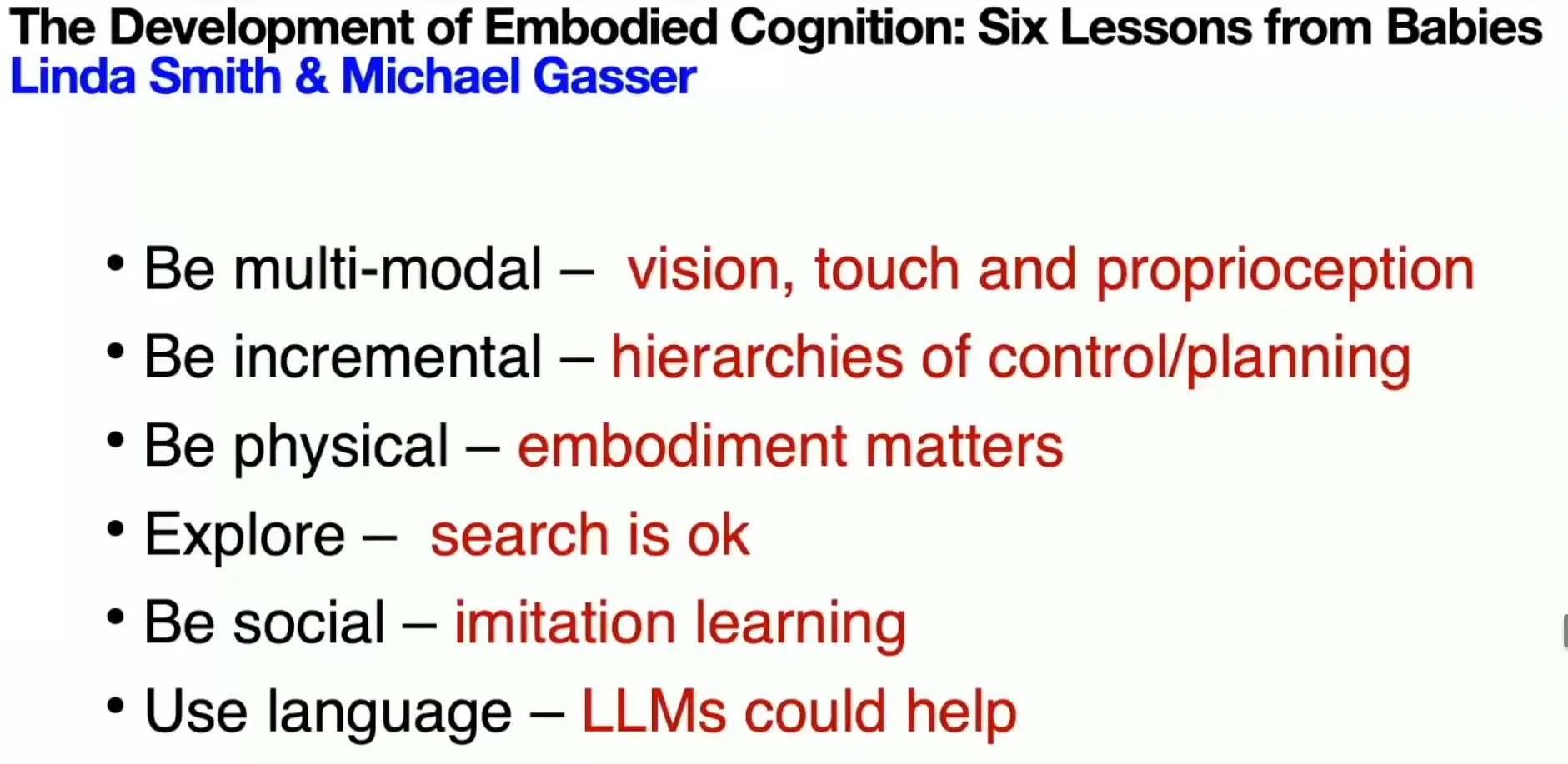
Multimodality: is human conciousness a continuous stream of sensory inputs? or is it more like a sequence of discrete thoughts? or is it something else entirely?
- What about muscle memory?
- Is embodiment essential to learning? You can’t learn without a body? or is it just a helpful tool?
- Relationship between brain and body
Agents
3 pillars of AI:
- Data
- Compute
- Algorithms
Pruning:
- The human brain actually prunes synapses over time, especially during childhood and adolescence. More efficient computing but less learning potential? But some people learn better because they find methods that suit them? A meta-learning algorithm that finds the best learning method for you? Or is it just trial and error? Highly likely to be RL
So a bunch of bots that are equipped with sensors that connect to a model that output “actions” and “thoughts” at differing frequencies on each stream. All have the same meta-learning algorithm. We let them interact in kindergarten settings and graduate the ones that show signs of maturity and learning potential. Then we put them in more complex environments
curriculum training:
Turing: Instead of trying to produce a programme to simulate the adult mind, why not rather try to produce one which simulates the child’s? If this were then subjected to an appropriate course of education one would obtain the adult brain. Presumably the child-brain is something like a notebook as one buys it from the stationer’s. Rather little mechanism, and lots of blank sheets. Our hope is that there is so little mechanism in the child-brain that something like it can be easily programmed. The amount of work in the education we can assume, as a first approximation, to be much the same as for the human child.